A clinician reading a study through a head-mounted viewer needs to see a uniform field, distinguish subtle boundaries, and trust that what is on screen corresponds to what was captured. That makes uniformity and contrast behaviour more important than peak brightness, and it makes the optical stack part of the measurement rather than an afterthought. A 0.32-inch 800x600 micro OLED quoted at 2000 nits gives ample headroom for a well-designed viewer, and the work that decides whether the product is good lies in checking how that brightness and contrast survive the optics, across the field, at the grey levels that actually carry information.
Key takeaways
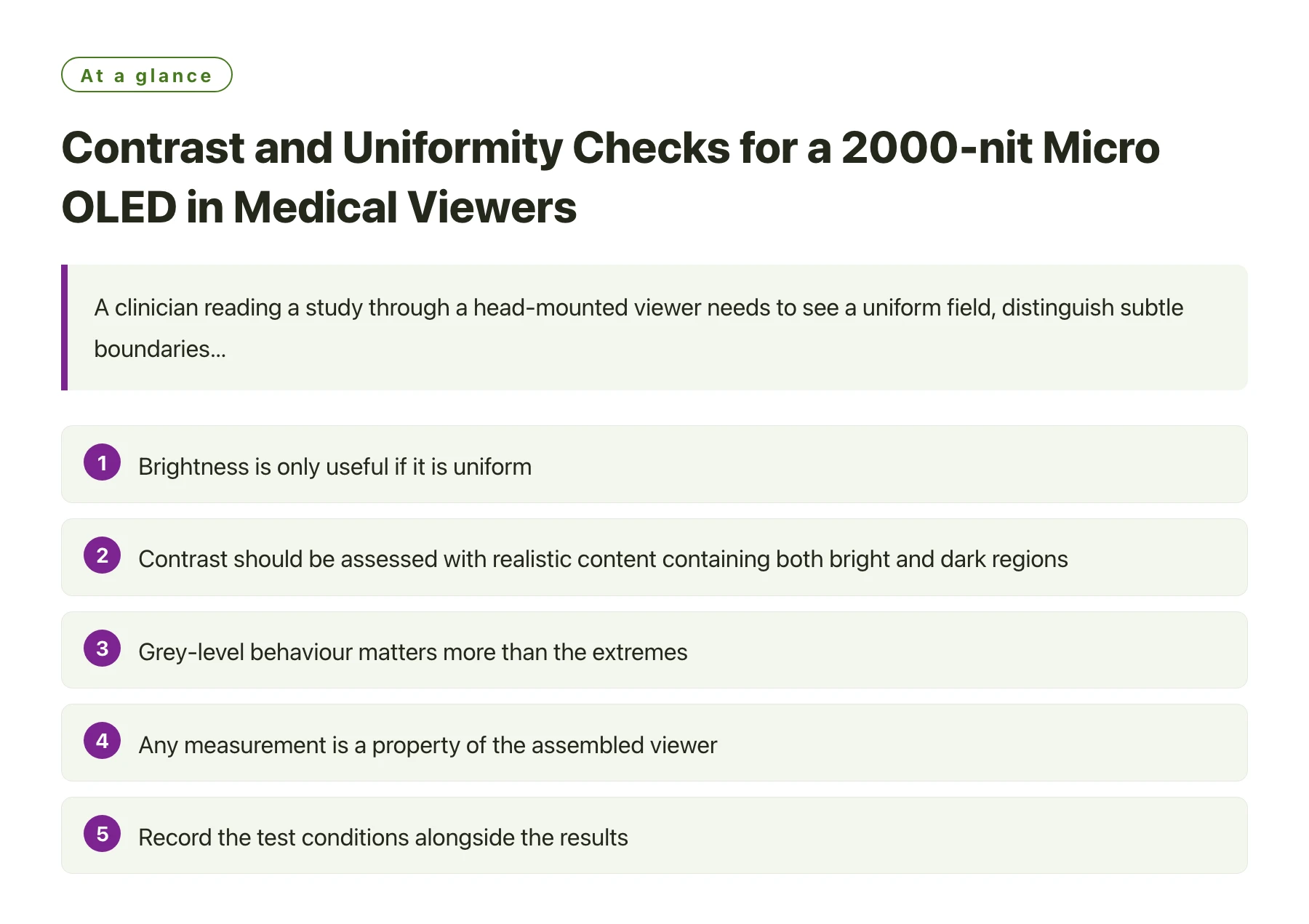
- Brightness is only useful if it is uniform; a viewer with bright centre and dim edges makes clinical reading harder, not easier.
- Contrast should be assessed with realistic content containing both bright and dark regions, not with full-screen patterns.
- Grey-level behaviour matters more than the extremes, because clinical images live in the middle of the range.
- Any measurement is a property of the assembled viewer, since the optics and housing both change what reaches the eye.
- Record the test conditions alongside the results, or the measurements cannot be repeated or compared across units.
Display testing often borrows its methods from consumer electronics, where the buyer wants a vivid picture. Clinical use wants something different: predictable reproduction. A viewer that renders a subtle boundary slightly too smoothly can hide the boundary entirely, and a viewer that renders it too harshly can invent structure that is not there.
That is why the measurements that matter here are about consistency across the field and across the grey range, rather than about peak figures. A display that is bright in the centre and marginal at the edges is a worse clinical tool than a dimmer display that is even.
The sections below describe what to measure, how to measure it in a way that reflects the assembled product, and the pitfalls that make results look better than reality.
What a clinical viewer has to get right
The task is to convey information the eye can interpret reliably. Boundaries between structures, differences in density and the overall shape of a region all depend on the display reproducing relative luminance faithfully. That is a different requirement from producing a striking image.
Uniformity comes first because it affects everything else. If the left side of the field is dimmer than the right, then the same structure appears different depending on where it sits in the frame, which introduces exactly the kind of inconsistency a viewer should remove.
Contrast comes second, and it has two components. The panel's own range sets the limit, and the optical housing determines how much of that range survives. Stray light inside the assembly lifts the blacks and washes out subtle differences, which is a mechanical problem that no display specification can fix [1].
Measurements worth making on the assembled viewer
- Centre and edge luminance at a fixed drive levelUse a single pattern and measure at the centre plus at least four points near the edges of the field. Uniformity is the ratio between the extremes.
- Grey ramp responseStep through the grey levels the application actually uses and record displayed luminance at each step. The shape of the curve matters as much as its endpoints.
- Contrast with realistic contentDisplay a scene containing both bright and dark regions and measure the black level away from the highlight. Full-screen patterns hide the effect of stray light.
- Off-axis behaviourRepeat the centre measurement with the detector moved across the exit pupil to represent different eye positions [2].
- Colour stability across the fieldCompare the same grey patch at the centre and the edges. A shift that is imperceptible on a test chart can bias the reading of a colour-coded overlay.
- Repeat after thermal soakRun the viewer for an extended period and repeat the measurements. Behaviour that drifts with temperature should be known before, not after, a clinical evaluation.
Common testing mistakes and their consequences
| Mistake | Why it flatters the result | Better approach |
|---|---|---|
| Measuring a bare panel | Removes the losses and stray light that the user actually experiences | Measure the assembled viewer at the exit pupil, with the housing in its final state |
| Using only full-screen black and white | Cannot reveal the veiling glare that a bright object causes in the rest of the field | Use scenes with local bright regions against dark backgrounds |
| Reporting a single centre reading | Hides non-uniformity that changes how structures are read across the field | Measure several points and report the ratio between the brightest and dimmest |
| Ignoring grey levels | Clinical content rarely uses the extremes, so endpoint measurements describe the least used part of the range | Characterise the ramp and report behaviour in the middle of it |
| Testing at one temperature | Thermal drift is a common source of unit-to-unit variation | Soak the unit and repeat the measurement before drawing conclusions |
Turning measurements into an acceptance criterion
Measurements are only useful if they lead to a decision. For a clinical viewer, that usually means a small number of criteria expressed as limits: minimum luminance at the dimmest point of the field, maximum variation across the field, and an acceptable range for the grey ramp. Each should be measurable with the equipment the production line actually has.
The temptation is to over-specify, write a long list of criteria, and then discover that half of them cannot be tested economically. A better approach is to identify the characteristics that determine whether the device is usable, measure those precisely, and treat everything else as information rather than as a gate [3].
The chosen criteria should also be recorded with the conditions under which they were measured. A uniformity figure means little without the drive level, the pattern and the temperature, and a criterion that cannot be reproduced will be argued about rather than applied.
The published specification for a module such as this one is available from DisplayModule, and it is a starting point rather than an answer. The numbers that decide whether a clinical viewer is acceptable are the ones you measure through your own optics, with your own housing, on your own content. Budget the time to make those measurements before the design freezes.
Sources
Frequently asked questions
Why is uniformity more important than brightness in a medical viewer?
Because clinical reading depends on comparing structures across the field. If luminance varies from one side of the image to the other, the same tissue or boundary looks different depending on where it sits, which undermines exactly the judgement the viewer is meant to support. A uniform dimmer image is usually more useful than a bright uneven one.
Should display measurements be made on the panel or on the assembled viewer?
On the assembled viewer. Optics, coatings and the housing all change what reaches the eye, and stray light inside the assembly can reduce the contrast that the panel provides. Measuring a bare panel gives a number that describes a component rather than a product.
How many points should be measured to characterise uniformity?
Enough to catch the pattern, not enough to make the test impractical. A centre measurement plus four points near the field edges usually reveals the extent of any falloff, and adding an off-axis measurement at the exit pupil covers the range of eye positions the user will adopt.
What conditions should be recorded with display measurements?
At minimum the displayed pattern, the drive level, the measurement distance and position, and the temperature of the unit. Without those, a result cannot be reproduced, compared across units or defended when a supplier or a reviewer questions it.