Caring for Slim White Oak Cabinets
A pale painted door is easy to keep clean and easy to ruin, and the difference is almost always abrasion rather than dirt. CasaBuilt finishes this door with seven layers of paint and a UV protective topcoat over a rubberwood frame and an MDF panel, which means the surface you touch is a film, not bare timber. Treat the film gently and it will outlast the trend that put it in the room.
Key takeaways
- Seven coats of paint plus a UV topcoat sit over an MDF panel in a rubberwood frame, so the surface is a film.
- Damp, not wet: standing water in the frame-to-panel joint is the main avoidable cause of damage.
- Abrasive pads and solvent sprays dull the topcoat, and a dull patch cannot be blended back.
- Sample doors cost $9.99 and the fee is refundable with a cabinet purchase, which makes them cheap test panels.
What the finish will and will not tolerate
The published build is a rubberwood frame with an MDF panel, painted in seven layers with a UV protective finish. Those are two different materials under one paint film. The film is what you clean, and everything below it stays protected only as long as the film is intact, which is why edges, screw holes and the joint around the panel deserve more care than the middle of a door.
Water is fine on the face and unhelpful in the joint. A cloth wrung out until it stops dripping is the right tool; a soaking sponge pushes water into the frame-to-panel line, where it sits against bare MDF and swells the panel edge. The same rule applies at the bottom rail of a base door, which is close enough to the floor to take a mop hit.
Solvents and abrasives are the other limit. A solvent spray cuts through grease quickly and takes a little of the topcoat with it, leaving a patch that reflects light differently from the rest of the door. An abrasive pad does the same thing more slowly. Neither is necessary for food splatter, fingerprints or dust, which all lift with mild dish soap and water.
Heat is a gentler problem but a persistent one. The doors beside and above a range collect a fine grease film that is invisible until it traps dust and turns tacky. Wipe those doors weekly; a film left for a year needs a degreaser, and a degreaser is what stresses the finish.
A ten-minute weekly routine
Work from the top of the room down, because dust falls. Upper cabinet doors first, then the exposed wall and backsplash, then the base cabinets and finally the toe kick. Two cloths are enough: one damp with a drop of mild dish soap, one dry to take the streak off before it dries.
Four zones carry most of the dirt. The area around each pull collects hand oil. The bottom rail of every base door collects mop water and pet hair. The frame-to-panel joint collects flour and dust, which a soft brush lifts better than a cloth. The underside of the uppers above the range collects airborne grease that never reaches the door face at all.
A kitchen used twice a day needs the weekly pass; a rental or a guest kitchen can take a monthly one. Consistency beats intensity. A door wiped gently every week never builds the film that forces a harsh cleaner, and a door cleaned once a year with a strong product usually ends up with a dull patch that gentle work cannot bring back.
Scuffs, grease and marks that need more than a wipe
Escalate slowly. Start with a dry microfiber cloth, then a damp cloth with dish soap, then a mild cream cleanser on a spot you cannot see. Give each step a minute to work instead of rubbing harder, because pressure is what burnishes the paint and leaves a shine mark under a window.
The slim white oak sample is the panel to test on. Reproduce the scuff on it, try the same cloth and the same cleaner, and check the sheen at an angle before the product goes anywhere near a cabinet face. At $9.99, refundable with a cabinet purchase, it is the cheapest insurance in the whole project.
Three things should stay in the cupboard. Melamine sponges are abrasive enough to dull a painted edge. Bleach and acidic cleaners attack the film and leave streaks that look like dirt from a distance. Oven cleaner should never travel: the aerosol lands on nearby doors and etches them, and the damage shows up days later when the light changes.
Sticky residue from tape or a label comes off with a warm damp cloth and patience. If it will not lift, a drop of cooking oil on a cloth will soften the adhesive, and the oil then comes off with dish soap. Solvent-based adhesive removers work faster and cost you the sheen.
Touch-up, warranty and the color reference
Touch-up on a pale painted surface is a sheen problem as much as a color problem. A dab of paint that matches perfectly will still flash under a downlight if it sits flatter or glossier than the factory finish, which is why small marks are often better left alone than painted over by hand. Clean the mark, look at it from the doorway, and decide whether it is visible from where anyone actually stands.
| Part or service | Published detail | What it means for cleaning |
|---|---|---|
| Door finish | 7 layers of paint with a UV protective finish | Wipe, do not scrub; the topcoat is the wear layer |
| Door panel | MDF panel in a rubberwood frame | Keep water out of the joint line |
| Cabinet box | 1/2" birch plywood | Wipe spills inside before they soak a seam |
| Face frame | 3/4" x 1-1/2" solid birch | Edges take knocks; dry them after cleaning |
| Shelves | 3/4" plywood, adjustable | Lift out for a proper clean twice a year |
| Drawers | 5/8" rubberwood, dovetail | Vacuum crumbs rather than washing the box |
| Warranty | 1 year, manufacturing defects | Report a defect before attempting a repair |
The warranty covers manufacturing defects in materials and workmanship for one year under normal residential use, and it is not a promise about wear. A scuff from a shopping bag is wear; a hinge that pulls out of a door with no impact is a defect. Report the second kind before touching it up, because a repair attempt can obscure the evidence that would have supported a replacement part.
Worked example: fourteen doors, seven families
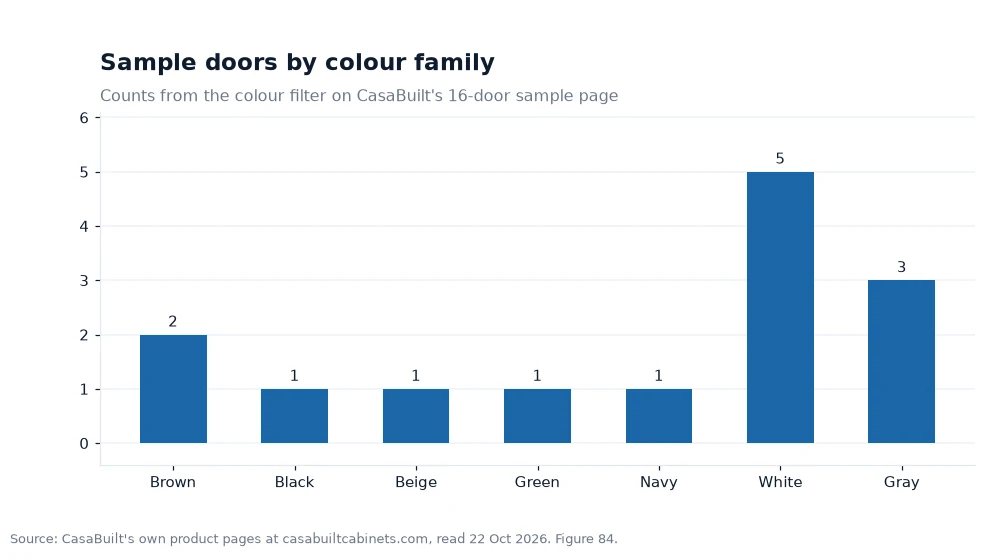
The chart counts the sample range by color family: Brown 2, Black 1, Beige 1, Green 1, Navy 1, White 5 and Gray 3. Add them in that order. Two plus one is three, plus one is four, plus one is five, plus one is six, plus five is eleven, plus three is fourteen. So the filter describes 14 doors across seven families.
White accounts for 5 of the 14, which is 5 divided by 14, or 35.7%. Gray accounts for 3, or 21.4%. Brown accounts for 2, or 14.3%. Black, Beige, Green and Navy account for one each, or 7.1% apiece, and those four singles add to 28.6%. Check the total: 35.7 plus 21.4 plus 14.3 plus 28.6 equals 100.0%.
Those shares explain the practical advice. More than half the range, 57.1%, sits in the White and Gray families, so a pale neutral is easy to source. At $9.99 per door, ordering one of each of the 14 tagged families costs 14 times $9.99, or $139.86. The page lists 16 door samples in stock, so treat the filter as a guide to the range rather than a stock audit, and note that the two premium doors, Black Quarterline at $19.50 and Beach Impression at $22.00, are priced separately.
Frequently asked questions
Can I use vinegar or bleach on a painted cabinet door?
Neither belongs on a painted finish. Vinegar is acidic and bleach is aggressive, and both can dull or streak the topcoat. Mild dish soap in warm water, applied with a wrung-out cloth and dried immediately, handles the grease and fingerprints a kitchen produces.
How do I clean the greasy doors above the range?
Wipe them weekly with warm water and a drop of dish soap so the film never builds, then dry with a soft towel. If the grease has already set, repeat the wipe several times rather than scrubbing, and test any degreaser on a sample door first.
Does frequent cleaning wear the finish out?
Gentle cleaning protects the finish; harsh cleaning wears it. The dull patches that appear over time come from abrasion and solvents, not from water and mild soap. Keep abrasive pads and solvent sprays out of the routine and the painted face will stay even.
Keep one door aside
Order a spare sample in the same finish and keep it flat in a cupboard, away from light. In three years it will be the only true reference for what the kitchen looked like when it was new, and it will be the panel you test a cleaner on before the cabinets see it.
Then build the routine around that panel: a damp cloth weekly, a dry towel every time, a soft brush in the joint, and no abrasives. Pale paint does not ask for much, but it does remember every shortcut.
Figures quoted here come from the manufacturer's own website, read 22 Oct 2026[1].